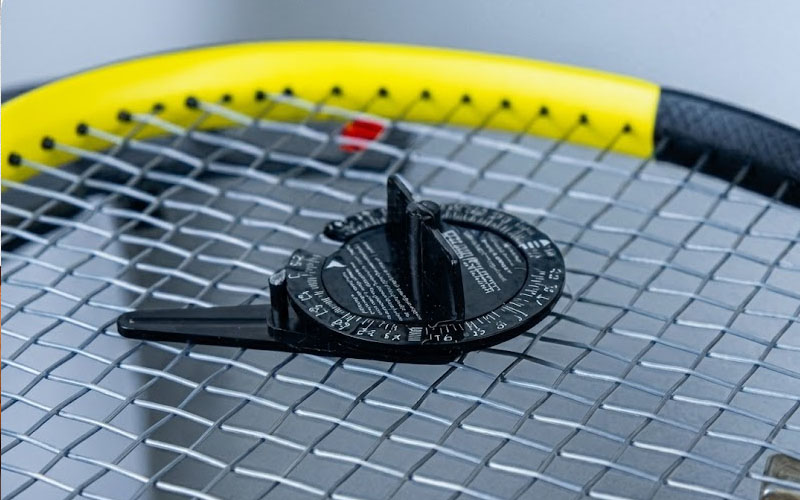
A low tension is recommended on dense string patterns (18/20), on small head sizes (less than 630 cm2), or for players looking for increased ball speed.
The tension range should be considered carefully, as it depends, as we mentioned, on your playing style, your racket, and the type of your string.
What tension to choose according to the string type?
Monofilament (Polyester and Co-Polyester)
The average tension for a monofilament is 23 kilograms. It is low below 21 kilograms and high above 25 kilograms. Above 26 kilograms, the string becomes particularly stiff and uncomfortable.
Multifilament and synthetic
The multifilament is on average strung at 25 kilograms. From 27 kilograms, the multifilament stiffens and loses its properties. At 22 kilograms and below, the tension is low and not recommended, otherwise the string will be uncontrollable.
Gut
The gut string is the most flexible string available. It is strung on average at one kilogram more than a multifilament.
What tension to choose for my tennis racket?
You must take into account the head size and also the string pattern of your racket. Indeed, the head size of your racket will influence the tension to apply. Take the average tension indicated above for a 645 cm² head size and adjust it by 1 kilogram for every 15 cm² difference. For example, you will lower the tension by one kilogram on a 630 cm² head size and increase it by 3 kilograms on a 690 cm² head size.
Have you changed your tennis racket and want to know what tension to string it at? Use our tension calculator.
What tension to choose according to my playing style?
The tension of your tennis string must be consistent with your playing style. Once you have defined the desired string type for your racket type, you will need to objectively identify your playing style to determine the most suitable tension for your game. To do this, are you a topspin player like Nadal? A flat hitter like Berdych or Medvedev? Or rather a player who varies their ball quality between topspin and flat shots?
If you have a very topspin game with very arcing balls, we recommend lowering the tension by 1 to 2 kilograms. Indeed, your balls travel a greater distance to reach the same point. Lowering the tension will favor ball rotation and speed to put more pressure on your opponent.
Is your game flat? Then increase your tension by one to two kilograms to gain ball control. Flat games tend to be risky with very small margins relative to the net. Increasing the tension will allow you to gain control and precision.
For players who use both moderate topspin and flat shots, maintain an average tension.
The gauge
The gauge will also influence the tension to choose. We advise you to lower the tension by one kilogram when you increase the gauge by 0.05mm. Increasing the gauge provides more control and less ball speed. This effect is therefore counteracted by lowering the tension to regain power and comfort.
Conversely, increase the tension by one kilogram when you decrease the gauge by 0.05mm to regain control, unless your goal is to maximize ball speed.
Our tips for choosing the right tension
We advise you to select the type of string based on your breakage frequency.
- Occasional string breaker: I break my string after 20 hours of play. I should therefore use multifilament or gut at a tension between 23 and 27 kilograms;
- Average string breaker: I break my string between 10 and 20 hours of play. I should therefore have an hybrid strung at a tension between 22 and 26 kilograms;
- Extreme string breaker: I break my string in less than 10 hours of play. I must use a monofilament at a tension between 21 and 25 kilograms.