Racket advice

Choosing the weight of your tennis racket

Whether you are a beginner or experienced tennis player, the weight of the tennis racket you play with will strongly influence your performance, your risk of injuries (tennis elbow) as well as several parameters of your game such as power, comfort, and maneuverability… We therefore offer you in this guide all the keys to know how to choose the weight of your racket.

Choosing the weight of your tennis racket
Expert guide Choice tips
Equipment

Choosing the right weight for your tennis racket

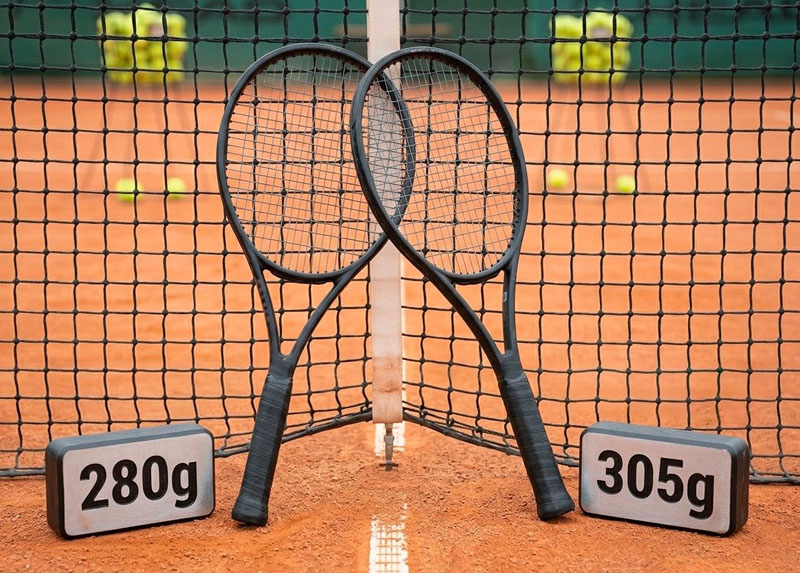
The choice of your racket's weight will depend on your age, build, and playing level. The heavier a racket is, the more power it will provide, the better it will absorb vibrations, but it will be difficult to handle and will require good technical mastery to exploit it. Conversely, a light racket will provide maneuverability, but will be less powerful. Therefore, do not overestimate your level, otherwise you risk limiting your progress. It is preferable to choose a lighter weight than too heavy to avoid muscle fatigue and thus a risk of injury. You can always add weight to a racket with lead if it turns out to be too light.

Age and build

Age and build will be important in choosing the weight of your racket. Up to 13 years old, a racket averaging from 255 grams up to 275 grams will be needed, depending on the young player's build. Generally, children's rackets are light with weight distributed in the racket head to provide more power.

From 15 years old, we advise players to use rackets around 285 grams or more, which will offer a good compromise between maneuverability and power. Women will prefer lighter rackets to improve maneuverability and easy power. Beginners can opt for rackets around 275 grams.
Skill level

Age and build should also be correlated with the player's skill level to find the ideal racket weight. Experienced players will tend to gravitate towards heavier rackets which will provide them with powerful and precise shots, whereas beginner players will benefit greatly from choosing a light and maneuverable racket.

Summary Table

What are the advantages by tennis racket weight?

Lightweight tennis racket

A lightweight racket will weigh up to 275 grams and will systematically have a head-heavy balance. It will favor maneuverability but offer less comfort. It's good to know that a lightweight racket absorbs less shock. It is essential to prioritize a multifilament string on lightweight rackets to absorb bad vibrations as much as possible and provide more power.

  • Advantage: excellent maneuverability
  • Disadvantage: comfort

Medium-weight tennis rackets

The average weight of a racket is between 280 grams and 300 grams. It has the advantage of offering good maneuverability as well as good power. Versatility is very good.

  • Advantage: good maneuverability
  • Disadvantage: improvable power

Heavy tennis racket

A heavy racket will have a mass of 300 grams or more. It has the advantage of offering good power, absorbing more bad vibrations, and being more stable on impact. Conversely, it will be less maneuverable and will require its owner to have a good level of play to exploit its mass. Therefore, do not overestimate your level of play, as this could limit your game progression.

  • Advantage: power, stability
  • Disadvantage: maneuverability

Balance and weight distribution

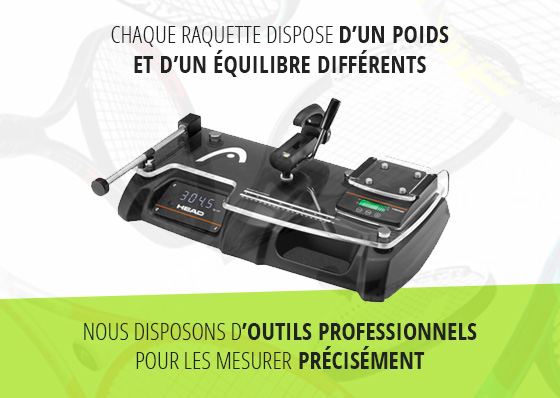
The weight of a tennis racket can be distributed along its entire length. You can have a racket with the same mass, but with a balance difference of up to 2cm. In this case, one will be much more powerful and the other much more maneuverable. We will therefore distinguish between rackets with a head-heavy balance and those with a handle-heavy balance:

  • A head-heavy racket will allow for more powerful shots, but will offer little maneuverability;
  • A handle-heavy racket provides excellent maneuverability, but will require hitting harder to regain power.

Modifying the weight and balance of your racket

If you have a racket that is too light for your needs, it is always possible to rebalance its weight using adhesive lead or tungsten strips. Depending on where these strips are placed, they can add more weight to the head or handle to modify the racket's balance. The strips can therefore be placed on the racket head under the practical protection strip or inside the frame, in the heart of the racket, or even between the handle and its grip.

Ready to take action?

Discover our selection of products tailored to your needs.

See our tennis rackets