Racket advice

The importance of twistweight on a tennis racket

Beyond weight and balance, an often-overlooked parameter radically influences your comfort and effectiveness: the twistweight. This measure of your racket's stability during off-center hits is the key to more forgiveness, precision, and fewer injuries. Understanding and mastering this criterion means moving from the status of a player who is subjected to their equipment to one who controls it.

The importance of twistweight on a tennis racket
Expert guide Technical advice

The art of customization: take control

If your racket is almost perfect but lacks a touch of stability, customization is the solution. Thanks to a few grams of lead or tungsten, judiciously applied, you can transform its feel... without changing the frame.

Equipment

Strategic placement points

Placement at 3 and 9 o'clock: pure stability

Most effective method to increase twistweight. Adding 2–4 g (1–2 g on each side) greatly improves stability without significantly impacting swingweight.

+ 5 g ≈ +10% twistweight: a noticeable gain for most regular players.

Placement at 10 and 2 o'clock: the power / stability compromise

Increases both twistweight (stability) and swingweight (power, « plow-through »). Ideal for players seeking an overall performance gain.

Placement at 12 o'clock: priority to power

Mainly emphasizes swingweight (power at the racket head). Minimal impact on twistweight.

Placement in the handle: balance & maneuverability

Adding weight to the handle (silicone, tungsten putty) makes the racket more head-light. Almost no effect on twistweight but improves overall stability, useful for volleys and slices.

A game of compromise

Customization is never isolated: each addition modifies several parameters. Example: weight at 3 o'clock/9 o'clock increases the twistweight, but also slightly the swingweight and static weight. The challenge is to find the new dynamic balance that serves your game, and not just to "load" the racket.

Twistweight, a key variable

Twistweight is the measure of your racket's torsional stability. It determines tolerance on off-center hits, comfort, and injury prevention. The modern player no longer limits themselves to weight and balance: they integrate twistweight into their analysis and experiment with lead tape to optimize their feel.

Understanding this parameter means entering the realm of sophisticated players. Your racket then becomes no longer just a tool, but the perfect extension of your intention on the court.

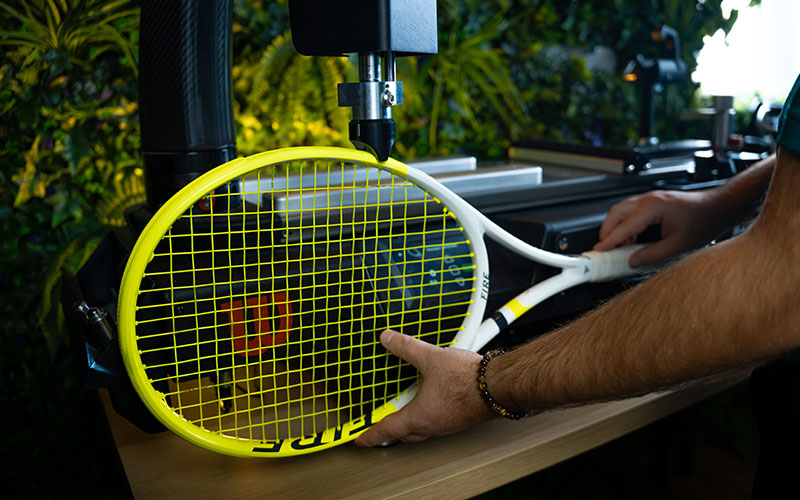
Before adding lead or tungsten at 3 o'clock and 9 o'clock to gain stability, you still need to start with a frame whose twistweight matches your game. Our range of tennis rackets offers profiles with different levels of torsional stability, to help you find the most suitable base before any customization.

Ready to take action?

Discover our selection of tennis rackets and compare their features to find the model that suits you.

View our tennis rackets