-10% with code FALL10

Racket advice
The Inertia (or swingweight) of a tennis racket
The inertia (or swingweight) of a tennis racket is a neglected, but essential measurement when choosing your racket.
This characteristic, measuring the effort required to rotate a racket around a given point, can greatly influence your performance on the court.
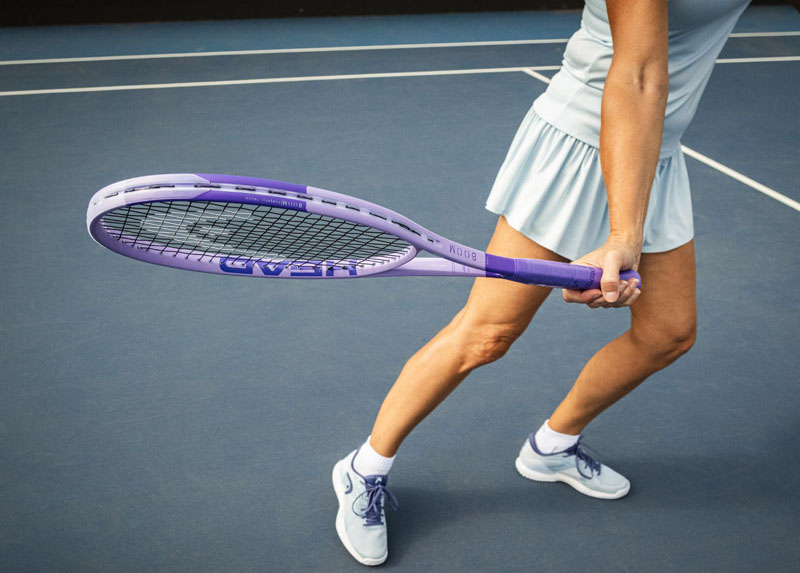
Expert guide
Technical advice
What is the swingweight of a tennis racket?
Inertia, or swingweight, represents the resistance of the racket when it is put into motion, especially during the swing. In other words, it indicates whether a racket is maneuverable or not. It is influenced by several parameters:
- The total weight of the racket: The heavier it is, the higher the inertia.
- Weight distribution: A head-heavy racket will have greater inertia than a handle-balanced racket.
- The length of the racket: Longer rackets naturally have higher inertia.
Inertia is expressed in units of kg·cm², and typical values range between 280 and 340 for standard tennis rackets.
Why is inertia important?
The inertia of a racket directly influences:
- Power: High inertia allows for more power generation, as the racket stores more kinetic energy.
- Maneuverability: Low inertia makes the racket easier to handle, ideal for quick exchanges or volleys.
- Comfort: Adapted inertia reduces muscle fatigue.
Main inertia categories
- Low inertia: it has a value below 300 kg·cm². The advantage is that these rackets are very maneuverable but provide less power. At the net or during very fast exchanges, low inertia allows for more reactivity.
- Medium inertia: the average value is around 310 kg·cm².
- High inertia: a value above 325 kg·cm² is considered high. These rackets will offer more power but will be less maneuverable. They are intended for players with a very good technical level to fully exploit them.
Can you modify the inertia of your tennis racket?
It is possible to increase inertia by adding lead, but it is not possible to lower this value other than by removing weight.
- By adding lead to the racket head, the increase in inertia will be significant. This will give you more power and stability, but it will be harder to maneuver the racket, leading to greater muscle fatigue. The risk of tennis elbow is also increased. If you need more power, proceed sparingly.
- By adding lead to the handle, you very slightly increase inertia and improve control and maneuverability.
- By placing lead on the balance point, the inertia value will increase moderately. The impact on maneuverability is less noticeable since you are not affecting the balance. However, there will still be more muscle fatigue due to the increase in total weight.