String advice

Choosing the gauge of your tennis string

The gauge of your tennis string corresponds to its diameter. It will influence several parameters of your game such as power, control, lifespan, comfort, and spin. It is therefore important to pay close attention to it in order to make the right choice.

Choosing the gauge of your tennis string
Expert guide Selection tips

Gauge size

In France, the gauge size of a tennis string is expressed in millimeters (mm). It can range from 1.05mm to 1.40mm. In the United States, the gauge is expressed using these standards: 15, 15L, 16, 16L, 17, 18, 19, 20 (15 being the thickest and 20 the thinnest), which several manufacturers also use.

Here is a summary to help you:

Diameter in mm / US Gauge

  • 1.05 / 20
  • 1.10 / 19
  • 1.15 / 18
  • 1.20 / 17
  • 1.25 / 16L
  • 1.30 / 16
  • 1.35 / 15L
  • 1.40 / 15

The importance of gauge thickness

Thin or thick gauge?

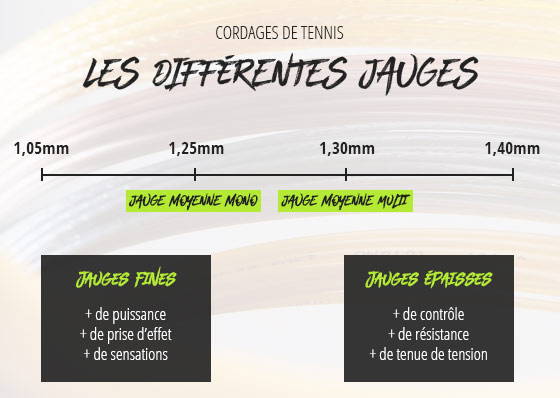
A tennis string gauge generally varies between 1.15mm and 1.40mm, even if some references may exceed or be below this range. Thin and thick gauges are distinguished depending on the type of string:

For all strings with a thickness below 1.25mm for monofilament and 1.30mm for multifilament, they will therefore be considered to have a thin gauge. For strings with a thickness greater than 1.25mm for monofilament and 1.30mm for multifilament, they will be considered to have a thick gauge.

Power / Control

The thinner a gauge is, the more power it provides, because it deforms more easily to return energy. A thicker gauge offers less ball speed and improves ball control.

Comfort / Feel

A thin gauge allows for a better feel of the ball and provides more feedback from the string. Touch players love it. It also allows you to exert less force to propel the ball, so you will play more relaxed.

Spin / Durability

The thicker the gauge, the more resistant the string will be to breakage. However, the thinner the gauge, the more the string will move laterally to return to its place. This movement occurs in a few milliseconds (invisible to the naked eye). The faster this movement, the more the string transmits rotation to the ball and thus spin.

Summary

The thin gauge will provide you with: Power, Comfort, Spin, Feel.

The thick gauge will provide you with: Control, Durability.

Making the right choice

Which gauge to choose for my tennis string?

The gauge to choose will depend on the type of string used, the characteristics of your tennis racket, and your game. If you don't know which gauge to choose, opt for the standards: 1.30 for multifilaments, natural gut, synthetics, and 1.25mm for monofilaments.

01

Gut, multifilament and synthetic

Gut, multifilament or synthetic strings are quite flexible and have a good power reserve. If your game lacks ball speed, you can find gauges starting at 1.18mm in these string families. For string breakers, you can choose a gauge up to 1.40mm. Gauges of 1.25 are also recommended for stringbeds of 615cm2 and less.

02

Monofilament

Monofilament string is more rigid and deforms less on impact than other string families. It naturally provides less power and more control. The classic gauge is therefore thinner and corresponds to 1.25mm.

03

The stringbed

The stringbed corresponds to the strung surface of your racket. The larger this surface, the more power and tolerance it provides. A standard stringbed is 645cm2. When you  have a racket with a large stringbed (greater than 660cm²), you can increase the gauge by one size. Conversely, you can lower the gauge on stringbeds smaller than 630cm².

04

The string pattern

There are several types of string patterns. The most common is 16×19 (16 vertical and 19 horizontal strings) but you can also find 18×20 string patterns. The fewer strings in the stringbed, the more your string will work and thus offer more power, spin, and an increased risk of breakage.

If you break frequently, you can opt for monofilaments of gauge 1.35 or even 1.40mm, but in this case, remember to lower the tension. There are tennis rackets with a head size larger than 660cm² having a 16×19 string pattern. In this case, we can only advise you to increase the gauge of your tennis string.

Different scenarios

I'm starting tennis and don't know which gauge to choose for my tennis string

Select a standard gauge: 1.30mm for gut, synthetic or multifilament, and 1.25mm for monofilament. When starting, you will in any case have to go through a testing phase to find the right gauge as well as the right tension adapted to your game and your racket.

I break my string every month

If you break a multifilament in less than 10 hours of play, we advise you first to increase the gauge and lower the tension by one kilo (if you are used to playing with a 1.30 gauge at 25 kilos, then switch to a 1.35 gauge at 24 kilos). If you still break too quickly, you can use a soft monofilament like Luxilon Element. You will triple or quadruple the lifespan of your string. Be careful, however, because monofilament loses its tension much faster than multifilament. It should be changed before 20 hours of play to maintain its initial qualities.

I frequently break my monofilament but I can't play with multifilament because I break it in less than 2 hours

Brands have developed very comfortable soft monofilaments that offer the feel of monofilament and comfort close to multifilament. This is the case with the Luxilon Element reference. You can also “hybridize” your monofilament with a multifilament in the crosses to offer it a gain in comfort.

Ready to take action?

Discover our selection of products tailored to your needs.

View our tennis strings