Ball advice

How is a tennis ball made?

Tennis balls are key elements of this sport popular worldwide. Their design is the result of a precise and sophisticated process, intended to guarantee optimal performance on the courts. But how exactly are they made? This article takes you behind the scenes of tennis ball manufacturing, from raw material to final product.

How is a tennis ball made?
Expert guide Practical information

The materials used to make a tennis ball

Rubber

The core of a tennis ball is made of rubber. This material is chosen for its ability to resist wear while maintaining its bouncing properties. Most tennis balls are made with a blend of natural and synthetic rubber, which ensures the ball's durability and performance.

  • Natural rubber: Gives the ball its elasticity.
  • Synthetic rubber: Provides resistance and extends the ball's lifespan.

Felt

The outer surface of a tennis ball is covered with felt. This felt, composed mainly of wool and nylon, is essential for the ball's control and precision. It also helps improve the ball's aerodynamics when struck.

  • Wool: Provides a soft texture and allows for better ball control.
  • Nylon: Offers greater wear resistance.
THE SECRETS OF TENNIS

The steps of manufacturing a tennis ball

01

The creation of the rubber halves

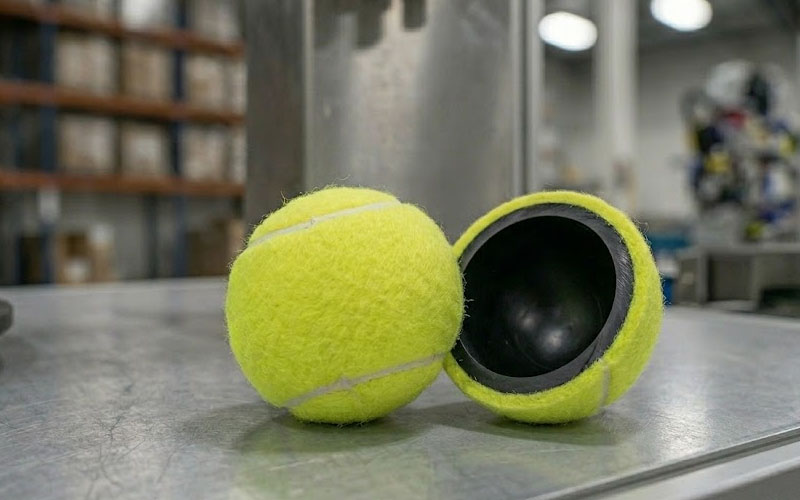
The process of manufacturing a tennis ball begins with the creation of two shell-shaped rubber halves. These halves are molded from a mixture of natural and synthetic rubber, then pressed into semi-spheres.

  • Pressing and molding: The rubber is heated and compressed to create the desired shape.
  • Cooling: The halves are then cooled to retain their shape.
02

The assembly of the rubber halves

The two rubber halves are then assembled to form a hollow sphere. This step is done by applying a layer of adhesive along the edges of each half, then fusing them together under high pressure.

  • Fusion of the halves: Assembly under high temperature ensures a solid joint between the two parts.
  • Pressurization: The ball is pressurized to allow it to have its characteristic bounce.
03

The addition of pressure

One of the peculiarities of tennis balls is that they are pressurized. During assembly, compressed air is injected inside the ball to give it its bounce. This internal pressure is essential to ensure that the ball bounces correctly when struck.

  • Internal pressurization: Air is injected before the halves are completely sealed.
  • Bounce control: Tests are carried out to ensure that the ball bounces according to the standards set by the International Tennis Federation (ITF).
04

The addition of felt

Once the rubber sphere is assembled and pressurized, the final step is to add the felt. Two "bean-shaped" pieces of felt are applied around the ball. These pieces are glued to the surface of the ball and fused to create a uniform covering.

  • Felt application: The felt is glued and pressed onto the ball to give it its distinctive texture.
  • Finishing: Once the felt is in place, the ball is heated to ensure that the felt adheres perfectly to the rubber.
05

Quality control

Before being commercialized, tennis balls must undergo rigorous quality control. Each ball is tested to verify that it meets the weight, size, and bounce standards defined by the ITF.

  • Bounce test: Balls are dropped from a determined height to check their bounce.
  • Visual inspection: Each ball is inspected to ensure that the felt is properly applied and that the ball is free of defects.

The manufacturing of a tennis ball is a complex process that combines technology and expertise. From molding the rubber halves to applying the felt, each step is essential to guarantee the quality and performance of the balls used during matches.

Ready to take action?

At Extreme Tennis, we offer a wide range of tennis balls designed to the highest standards, so you can always enjoy the best experience on the court.

See our tennis balls